
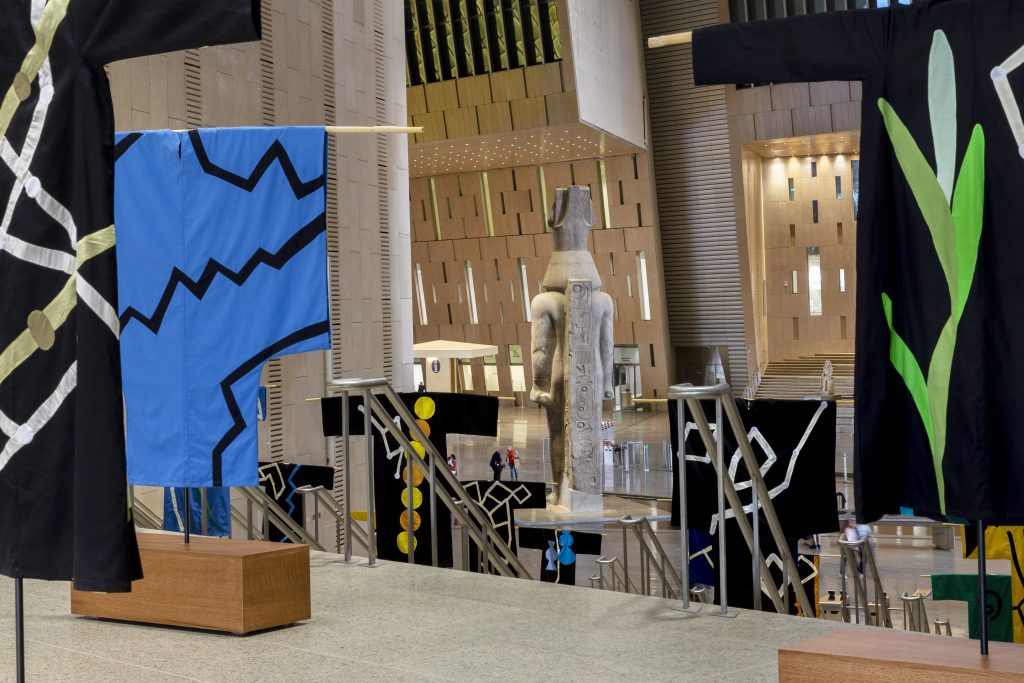


Susan Hefuna’s 2023 exhibition Traces of Egypt brought the centuries-old Khayameya textile tradition into a contemporary installation at the Grand Egyptian Museum.
The German-Egyptian artist collaborated with local artisans to create 28 costumes from Egyptian cotton.
Dots, lines and architectural memory
The garments used connected dots and linear structures associated with Hefuna’s drawing practice.
The same visual language also referred to the wooden mashrabiya screens that had appeared throughout her earlier work. Their geometric patterns filter light and visibility, linking domestic architecture with questions of privacy and perception.
In the costumes, these elements moved from drawing and architecture onto the body.
Living heritage rather than historical imitation
Khayameya is associated with decorated tent textiles and a long tradition of appliqué work in Egypt.
Hefuna used the collaboration to argue that heritage remains alive when contemporary artists and craftspeople adapt it rather than treating it only as a museum artefact.
The exhibition was the Grand Egyptian Museum’s first presentation devoted to contemporary art. That context placed the costumes beside an institution primarily associated with ancient Egyptian collections.
Traces of Egypt did not attempt to imitate a historical style unchanged. It connected artisan knowledge, Egyptian cotton and Hefuna’s established visual vocabulary through works designed for a present-day exhibition.
The result showed how a museum devoted to the past could also provide space for artists examining how cultural forms continue to move through material, labour and the human body.